1
Fanfare for the Common Man
A perfect entry point—just five minutes of pure, uncluttered American optimism that immediately reveals why Copland matters.
1900–1990
92 works · 8 upcoming works performed
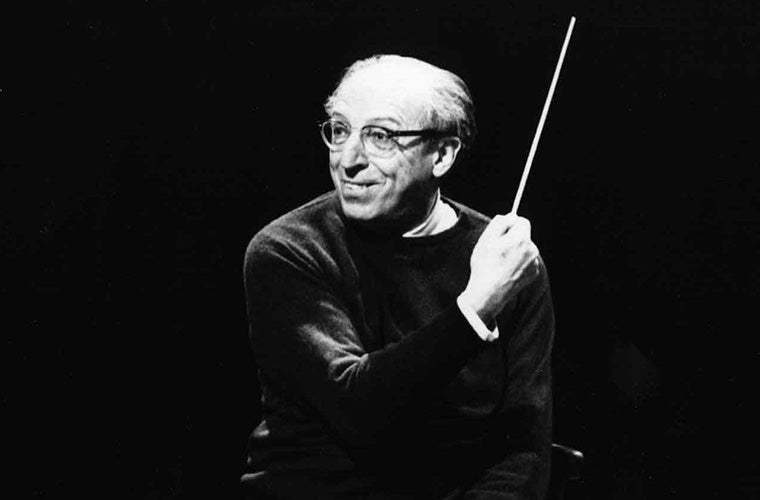
Aaron Copland is the composer who made American classical music sound unmistakably American—without a hint of self-consciousness or pastiche. Born in Brooklyn to a Russian-Jewish immigrant family, he became the voice of the American frontier, small towns, and common folk through ballets and symphonies that feel as natural as breathing. His music doesn't announce itself as "American"; it simply *is*, and that's precisely why it endures.
8 concerts featuring works by this composer



Never miss a Copland performance
Get notified when new concerts are announced near you
New to Aaron Copland? These works make great entry points.
A perfect entry point—just five minutes of pure, uncluttered American optimism that immediately reveals why Copland matters.
The ballet's concert suite is Copland's most beloved work and the ideal introduction to his mature style: accessible, deeply moving, and impossible to forget.
For newcomers who want something joyful and energetic, these episodes deliver irresistible American flavor with none of the heaviness of a full symphony.
Add to Spotlight to be notified when a piece is scheduled near you.
The works that define Aaron Copland's legacy.
Appalachian Spring: Ballet
This 1944 masterpiece—built on the Shaker hymn 'Simple Gifts'—is Copland distilled to pure essence: American optimism, spiritual depth, and perfect orchestral clarity in one transcendent score.
A rollicking celebration of American frontier life featuring 'Hoedown,' this ballet captures the joy and vitality of the American spirit with infectious melodies and brilliant orchestration.
A profound meditation on American democracy that interweaves Lincoln's own words with Copland's noble, austere orchestration—essential listening for understanding how classical music can honor national identity without bombast.
Copland's most ambitious symphonic work, culminating in a massive statement of the 'Fanfare for the Common Man,' it represents the summit of his orchestral thinking and remains one of the great American symphonies.
Billy the Kid: Ballet
A vivid, narratively gripping ballet that uses folk and cowboy songs to tell an American legend, demonstrating Copland's gift for making popular material into concert-hall art.
Musical style, influences, and more
Copland's genius lies in his ability to weave folk melodies, hymn tunes, and open-interval harmonies into sophisticated modernist structures without ever feeling forced or nostalgic. He strips away European Romanticism's excess, favoring transparent orchestration, wide-open spaces in the harmony, and a folk-like directness that invites rather than overwhelms. His harmonic language—sparse, modal, with unexpected clashes—creates a distinctly American sound that influenced generations of film and concert composers.
Copland studied with Nadia Boulanger in Paris, where he absorbed European modernism before consciously choosing to root his music in American sources. He admired the experimental spirit of his American contemporaries like Roy Harris and Virgil Thomson, and was shaped by his deep engagement with American folk traditions, jazz rhythms, and the social consciousness of Depression-era culture. His mentorship of younger American composers and his tireless advocacy for American music made him not just a composer but a cultural ambassador.
Copland's early works (1920s–30s) show modernist experimentalism influenced by Stravinsky and the European avant-garde, but after a trip to Mexico and deepening engagement with American folk sources, he shifted toward the accessible, richly melodic style for which he's famous. His great ballets—*Rodeo*, *Billy the Kid*, *Appalachian Spring*—emerged in the 1940s as his mature voice crystallized. His later works returned to greater complexity and abstraction, showing he never abandoned modernist rigor even as he championed populism.
In 1942, Copland composed the 'Fanfare for the Common Man' as a patriotic gesture during World War II—a brass fanfare celebrating ordinary Americans. The work became so beloved that he later incorporated it into his Third Symphony, and it has since become almost an unofficial second national anthem, played at presidential inaugurals and state occasions. What began as wartime morale-boosting became a permanent part of American identity.
While Copland is celebrated for his ballets and orchestral works, his 8 Poems of Emily Dickinson for voice and orchestra is a masterpiece of song composition that deserves far more concert time—it's intimate yet orchestrally adventurous, and reveals a subtle, introspective side often overshadowed by his grander populist works. Additionally, his extensive film scores (*Our Town*, *The Heiress*, *Of Mice and Men*) are concert-worthy pieces in themselves, not mere background music.
Copland remains a staple of American orchestral programming—*Appalachian Spring*, *Rodeo*, and *Fanfare for the Common Man* are fixtures at pops concerts and classical series alike. However, his deeper works (the later symphonies, the Emily Dickinson cycle, chamber works) are less frequently performed, presenting exciting opportunities for discovery. Recent years have seen renewed interest in his complete output, particularly his film scores and abstract modernist works, as musicians move beyond the 'greatest hits' to appreciate the full arc of his genius.
92 works in catalog
Browse the catalog below. Add any work to your Spotlight to track when it is performed live.
Showing 30 of 92 works