1
Kol Nidrei for Cello and Piano
A hauntingly beautiful setting of the most recognizable Jewish melody, emotionally direct and technically accessible.
1889–1946
1 work
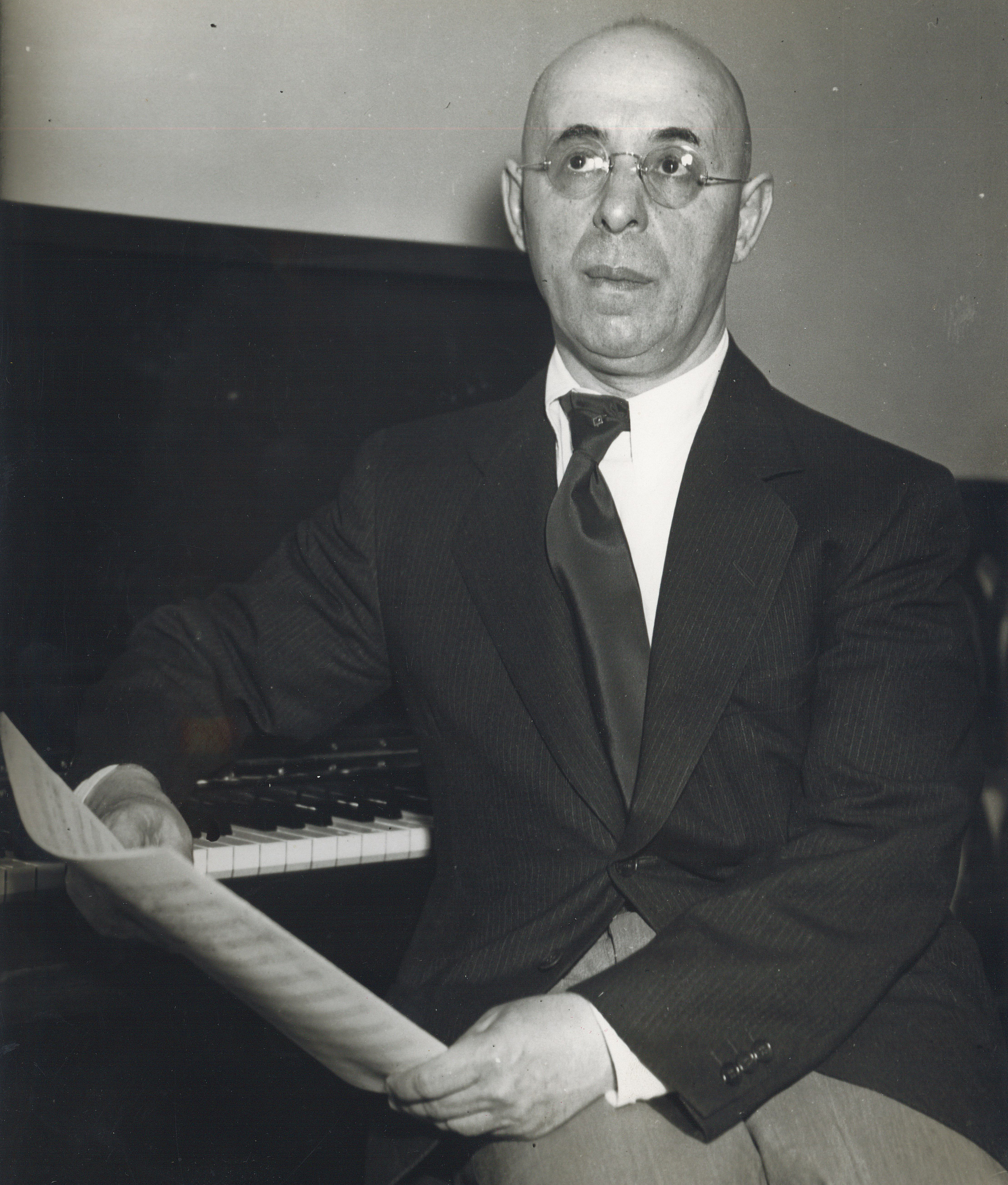
A Ukrainian-born composer and ethnomusicologist who dedicated his life to preserving and transforming Jewish liturgical music. Working in the early 20th century, Rosowsky bridged the worlds of synagogue chant and Western classical composition, creating works that honored tradition while embracing modern harmonic language. His scholarship on cantorial music remains foundational.
0 concerts featuring works by this composer
No upcoming performances scheduled for works by Alexander Rosowsky.
New to Alexander Rosowsky? These works make great entry points.
Kol Nidrei for Cello and Piano
A hauntingly beautiful setting of the most recognizable Jewish melody, emotionally direct and technically accessible.
Three Liturgical Pieces for Violin and Piano
Short, expressive works that showcase his melodic gift without requiring knowledge of liturgical context.
Sabbath Eve Service (excerpts)
Individual movements work beautifully as standalone pieces, revealing his gift for text-setting.
Add to Spotlight to be notified when a piece is scheduled near you.
The works that define Alexander Rosowsky's legacy.
Sacred Service for Sabbath Morning
His masterwork synthesizing synagogue tradition with modern compositional craft, creating a bridge between liturgical function and concert performance.
Liturgical Preludes for Organ
Demonstrates his ability to distill the essence of Jewish prayer modes into instrumental forms accessible to any listener.
The Music of the Syrian Jews
Though scholarly, this transcription collection reveals the melodic source material that shaped his entire compositional aesthetic.
Musical style, influences, and more
Rosowsky's music weaves the modal melodic contours of Jewish prayer into late-Romantic harmonic frameworks. His treatment of sacred melodies shows profound respect for their origins while allowing them to breathe within chromatic, expressive harmonies. The result feels both ancient and emotionally immediate.
Deeply influenced by the cantorial traditions he documented, Rosowsky studied at the St. Petersburg Conservatory during the height of Russian nationalism in music. His work paralleled Ernest Bloch's Jewish-themed compositions, though Rosowsky maintained closer ties to actual liturgical practice. He mentored a generation of cantors and composers in the United States after emigrating.
His early work focused on collecting and notating traditional Jewish music across Eastern Europe. After emigrating to Palestine and then the United States, he shifted toward composition, creating liturgical works that synthesized his ethnomusicological research with concert hall techniques. His later years emphasized pedagogy and preservation.
Rosowsky fled the Russian Revolution with thousands of pages of transcribed cantorial melodies—an irreplaceable archive of Eastern European Jewish musical tradition that would have been lost to history. These transcriptions became the foundation for his compositional work and scholarly legacy.
Rosowsky published the first comprehensive transcription of the Babylonian tradition of Torah cantillation, a scholarly achievement that influenced composers far beyond the Jewish musical world, including those interested in ancient modal systems.
Rarely programmed outside Jewish cultural contexts, but experiencing a quiet revival as musicians rediscover his unique synthesis of tradition and modernism. His works appear most often in programs exploring Jewish musical heritage or early 20th-century émigré composers.
1 works in catalog
Browse the catalog below. Add any work to your Spotlight to track when it is performed live.
Showing 1 of 1 works