1
Density 21.5 for Solo Flute
A short, focused work that introduces his approach to timbre and line without overwhelming forces.
1883–1965
19 works
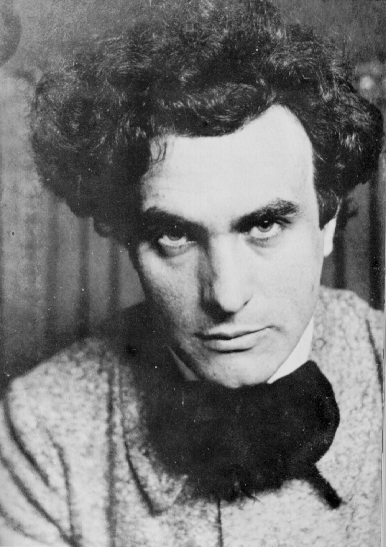
Varèse called himself an organizer of sound, not a composer, and he meant it—his music treats noise, rhythm, and timbre as primary elements, melody and harmony as optional extras. He dreamed of electronic music decades before the technology existed and created acoustic works that sound like they're being transmitted from another planet. He's the patron saint of every experimental musician who's ever questioned what music even is.
0 concerts featuring works by this composer
No upcoming performances scheduled for works by Edgard Varèse.
New to Edgard Varèse? These works make great entry points.
A short, focused work that introduces his approach to timbre and line without overwhelming forces.
Chamber-scale but fully representative of his sound-mass thinking.
Despite being radical, its thirteen minutes are so viscerally exciting they hook listeners immediately.
Add to Spotlight to be notified when a piece is scheduled near you.
The works that define Edgard Varèse's legacy.
The first Western concert work for percussion ensemble alone—a seismic shift in what music could be.
Eight minutes of pure electronic sound that redefined spatial and sonic possibilities in music.
Déserts for Winds, Percussion, and Tape
His integration of live performance and electronics remains startlingly original.
Musical style, influences, and more
Varèse built his music from 'sound masses'—blocks of timbre and rhythm that collide, fragment, and recombine rather than develop thematically. He favored extreme registers, unconventional instruments (sirens, anvils, theremins), and percussion orchestras. His music is all attack and decay, favoring sharp articulations and sudden silences over legato flow. Pitch is often organized by timbre rather than traditional harmony.
Studied with d'Indy and Roussel but rejected their approaches, finding inspiration instead in medieval organum, Busoni's futurist writings, and the sounds of urban industrial life. He influenced the electronic and experimental music movements decades after his most radical works. Cage, Stockhausen, and Xenakis all acknowledged him as a precursor.
His early works in France are lost, but by the time he moved to New York in 1915 he was fully formed as a radical. The 1920s brought his most famous acoustic works—'Hyperprism,' 'Octandre,' 'Ionisation.' When the technology finally arrived in the 1950s, he created 'Déserts' and the purely electronic 'Poème électronique.' Late works like 'Nocturnal' remained unfinished at his death.
When Varèse wrote 'Ionisation' in 1931—scored entirely for percussion and two sirens—critics called it a joke, a scandal, noise masquerading as music. Today it's recognized as a landmark that liberated rhythm from pitch and opened the door for percussion as an independent medium. Varèse just shrugged and kept writing what he heard.
Varèse spent decades trying to create electronic instruments and sought out Leon Theremin, but the technology to realize his sonic visions didn't exist until late in his life. Most of his career was spent writing acoustic approximations of sounds he could only imagine—when he finally got a tape studio, he was already in his seventies.
Varèse is a specialist favorite—percussion ensembles perform 'Ionisation' regularly, and new music groups program him frequently, but mainstream orchestras rarely touch his work. His small catalog (only about a dozen completed works) makes him seem marginal despite his massive influence. Recent years have seen increased recognition of his historical importance.
19 works in catalog
Browse the catalog below. Add any work to your Spotlight to track when it is performed live.
Showing 19 of 19 works