1
To a Wild Rose from Woodland Sketches
The perfect MacDowell introduction—simple, beautiful, and quintessentially American in spirit.
1860–1908
27 works
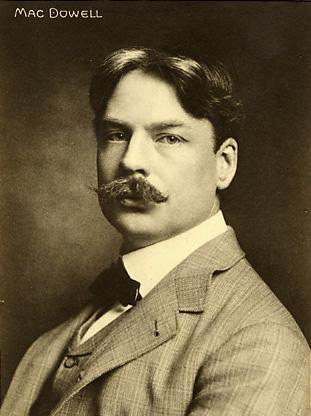
MacDowell was America's first internationally recognized composer, writing Romantic piano music that could hold its own with European contemporaries. His 'Woodland Sketches' and piano concertos brought American landscapes and Native American themes into the concert hall decades before Copland. Tragically, mental illness cut his career short just as American music was finding its voice.
0 concerts featuring works by this composer
No upcoming performances scheduled for works by Edward MacDowell.
New to Edward MacDowell? These works make great entry points.
To a Wild Rose from Woodland Sketches
The perfect MacDowell introduction—simple, beautiful, and quintessentially American in spirit.
Witches' Dance, Op. 17 No. 2
A virtuoso showpiece that's exciting and accessible.
His most famous large work, blending European form with American spirit.
Add to Spotlight to be notified when a piece is scheduled near you.
The works that define Edward MacDowell's legacy.
Woodland Sketches, Op. 51
Ten piano pieces including 'To a Wild Rose,' his most famous work—perfectly crafted miniatures.
His most substantial work, a Romantic showpiece that deserves to be programmed alongside European concertos.
Atmospheric piano pieces that capture the ocean's moods with Impressionistic color.
Musical style, influences, and more
MacDowell's music is essentially late-Romantic in the Germanic tradition—Lisztian pianism, Griegian harmonies, and Brahmsian structures—but filtered through an American sensibility. His piano writing is idiomatic and gratifying to play, favoring rich textures and singing melodies. He excelled at atmospheric character pieces, creating sonic portraits of nature and legend with poetic titles and programmatic content.
Studied in Paris and Frankfurt, absorbing European Romanticism from its source. Liszt heard and praised his music, providing crucial encouragement. He was influenced by Grieg's national Romanticism and Wagner's harmonic language, though he created a gentler, more lyrical version of both. As America's first major composer, he had no native tradition to draw from, making his achievement all the more remarkable.
Achieved early success in Europe, with Liszt's endorsement launching his career. Returned to America as an established composer, becoming Columbia University's first professor of music. His most productive period was the 1890s, writing concertos, sonatas, and character pieces. Mental illness struck around 1905, ending his career and leading to his death three years later at just forty-seven.
MacDowell's final years were tragic—he developed what was likely neurosyphilis in his mid-forties, losing his memory and mental faculties. His wife Marian devoted herself to his care and after his death created the MacDowell Colony, which became America's first artist residency and has hosted countless composers, writers, and artists over a century.
MacDowell was also an accomplished poet and visual artist who created paintings and sketches—his artistic sensibility was genuinely multimedia, with his music often inspired by visual images or poetic ideas he'd developed in other media.
MacDowell is moderately programmed, with 'To a Wild Rose' as a recital staple and the Second Piano Concerto appearing occasionally on American orchestra programs. His larger works deserve more attention than they receive, as recent performances have proven their quality. He's experiencing a modest revival as American music history gets reassessed.
27 works in catalog
Browse the catalog below. Add any work to your Spotlight to track when it is performed live.
Showing 27 of 27 works