1
Figment for Solo Cello
A late miniature that introduces his intervallic thinking in concentrated form.
1908–2012
83 works
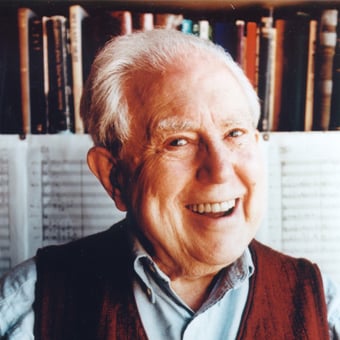
Carter lived to 103 and composed masterpieces into his hundreds, making him classical music's ultimate proof that complexity and innovation have no age limit. His music is fiendishly difficult—rhythmic layers that seem impossible, harmonies that refuse easy categories—yet it all serves expressive ends. He turned American modernism into a rigorous, uncompromising art.
0 concerts featuring works by this composer
No upcoming performances scheduled for works by Elliott Carter.
New to Elliott Carter? These works make great entry points.
Figment for Solo Cello
A late miniature that introduces his intervallic thinking in concentrated form.
What Next? (opera)
His only opera, surprisingly approachable with its surreal humor and dramatic pacing.
Scrivo in Vento for Solo Flute
Short, focused, and representative of his late style's refinement.
Add to Spotlight to be notified when a piece is scheduled near you.
The works that define Elliott Carter's legacy.
The work that announced his mature style, a forty-minute journey of unprecedented rhythmic and harmonic complexity.
A three-movement orchestral masterwork from his late period, showing his complexity achieving transparency.
A Mirror on Which to Dwell for Soprano and Ensemble
Six Elizabeth Bishop settings that reveal his lyrical side and gift for text-setting.
Musical style, influences, and more
Carter's mature music features extreme rhythmic complexity, with different instruments operating in independent tempos and meters simultaneously—a technique called metric modulation. His harmonies avoid triads, built instead from carefully calibrated interval sets, creating a chromatic but highly organized sound. Late works achieved a transparency and lyricism that made the complexity more audible, but he never simplified—he just got better at making difficulty beautiful.
Studied with Nadia Boulanger, absorbing neoclassical discipline, but evolved dramatically beyond it. The 1950s encounter with Ives's music and European modernism transformed his style. He absorbed Stravinsky's rhythmic thinking, Schoenberg's intervallic organization, and Varèse's sonic imagination while creating something uniquely his own. He influenced generations of composers at Juilliard and through his scores.
Early works were neoclassical, but his First String Quartet (1951) marked a radical break toward complexity. The next fifty years saw him refine his polyrhythmic language to near-impossible precision. Remarkably, his final two decades brought a late flowering—shorter, more concentrated works that maintained his rigor while achieving new expressive directness. He composed literally until his final months.
When Carter turned 100, major orchestras worldwide premiered new works he'd recently completed. At an age when most people have been retired for decades, he was producing some of his most refined and innovative music. He essentially invented the concept of the ultra-productive centenarian composer.
Carter was a championship-level tennis player in his youth and remained athletic into old age—the physical discipline and strategic thinking required for tennis paralleled his compositional approach, treating music as intellectual sport requiring both planning and spontaneity.
Carter is a specialist favorite, regularly programmed by new music ensembles and chamber groups, less so by mainstream orchestras. His string quartets are cornerstones of contemporary chamber repertoire. His music demands expert performers, which limits programming, but advocates insist the rewards justify the difficulty. He's a modernist classic whose reputation continues growing.
83 works in catalog
Browse the catalog below. Add any work to your Spotlight to track when it is performed live.
Showing 30 of 83 works