1
Passacaglia in G Minor for Solo Violin
A deeply moving set of variations for unaccompanied violin — simpler to follow than the full Mystery cycle, and a natural comparison point for Bach lovers.
1644–1704
1 work
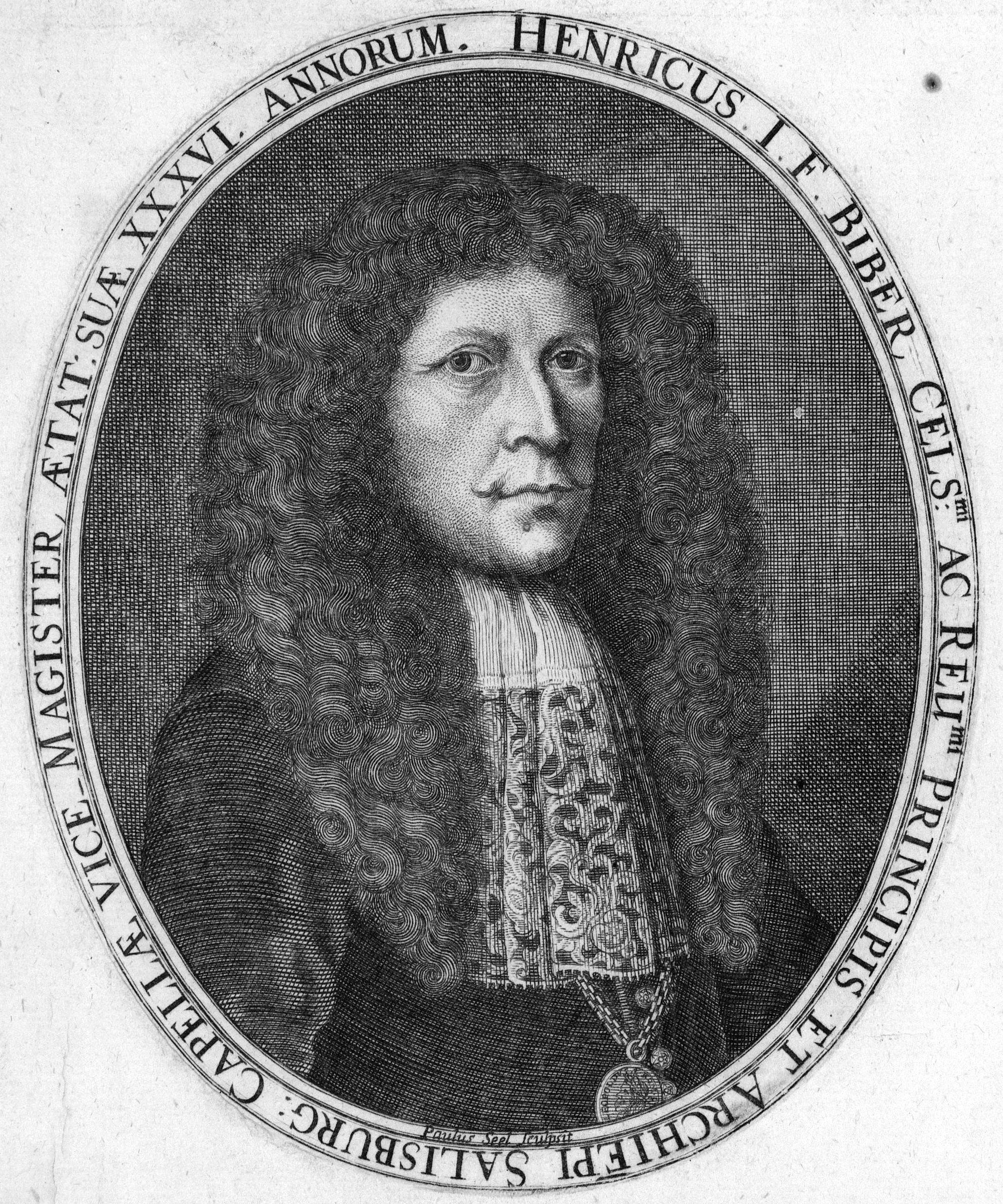
Heinrich Ignaz Franz Biber was the greatest violin virtuoso of the 17th century and a visionary composer whose Mystery Sonatas remain among the most extraordinary works ever written for the instrument. Based in Salzburg, he pushed the violin into expressive and technical territory that wouldn't be matched until Paganini, while also creating sacred music of overwhelming grandeur for the city's magnificent cathedral.
0 concerts featuring works by this composer
No upcoming performances scheduled for works by Heinrich Ignaz Franz von Biber.
New to Heinrich Ignaz Franz von Biber? These works make great entry points.
A deeply moving set of variations for unaccompanied violin — simpler to follow than the full Mystery cycle, and a natural comparison point for Bach lovers.
Battalia à 10
Vivid, theatrical, and short — its depiction of drunken soldiers and battle chaos makes it one of the most entertaining pieces of the 17th century.
Sonata Representativa in A Major
A delightful solo violin piece imitating birds, frogs, cats, and other animals — charming, virtuosic, and immediately accessible.
Add to Spotlight to be notified when a piece is scheduled near you.
The works that define Heinrich Ignaz Franz von Biber's legacy.
Mystery (Rosary) Sonatas for Violin and Continuo
Fifteen sonatas and a passacaglia depicting the Christian mysteries — a work of staggering technical innovation and spiritual depth that has no parallel in Baroque music.
Battalia à 10
A programmatic battle piece featuring polytonality, col legno, and deliberate cacophony that sounds astonishingly modern for 1673.
Missa Salisburgensis
A spectacular 53-part mass for the Salzburg Cathedral that is among the most grandiose achievements of Baroque sacred music.
Musical style, influences, and more
Biber's genius lies in scordatura — the systematic retuning of the violin's strings to create otherwise impossible sonorities, keys, and double-stop combinations. This technique, combined with his Bohemian-Austrian love of dramatic contrast, gives his music a kaleidoscopic color palette. His writing ranges from delicate, prayer-like devotion to wild theatrical extravagance, often within the same work.
Trained in the Central European tradition at Kroměříž, Biber absorbed Italian violin innovations and the polychoral grandeur of the Venetian school. He served the Salzburg Archbishop's court for most of his career, and the acoustic possibilities of Salzburg Cathedral directly shaped his monumental sacred works. His violin writing set the standard that influenced the North German school and ultimately Bach.
Biber began his career at the Kroměříž court of Bishop Karl Liechtenstein-Kastelkorn before his move to Salzburg around 1670. His Salzburg decades produced his greatest works — the Mystery Sonatas, the Battalia, and large-scale sacred music. He rose through the court hierarchy to become Kapellmeister, and was ennobled by Emperor Leopold I in 1690, an extraordinary honor for a musician of his time.
The Mystery Sonatas were apparently unknown to the broader musical world for over two centuries — the manuscript sat unperformed in the Bavarian State Library until it was rediscovered in the early 20th century. An entire masterpiece of Western music was essentially lost and found again, and we're still absorbing its implications.
Biber's son, Karl Heinrich Biber, also became a composer and Kapellmeister in Salzburg, but the father's most extraordinary works — the Mystery Sonatas — were essentially forgotten for over 200 years, meaning that generations of violinists had no idea what the instrument was capable of in 1674.
Biber has gone from near-total obscurity to being a staple of the Baroque specialist world, thanks to the period-instrument movement. Violinists like Andrew Manze, Rachel Podger, and Leila Josefowicz have championed the Mystery Sonatas. The Missa Salisburgensis occasionally receives spectacular live performances in large cathedral spaces. He's a reliable draw for audiences who love Baroque music's more theatrical side.
1 works in catalog
Browse the catalog below. Add any work to your Spotlight to track when it is performed live.
Showing 1 of 1 works