1
Les Indes galantes: Danse des Sauvages
An instantly exciting, rhythmically infectious dance that hooks listeners from the first bar — pure energy and color.
1683–1764
53 works
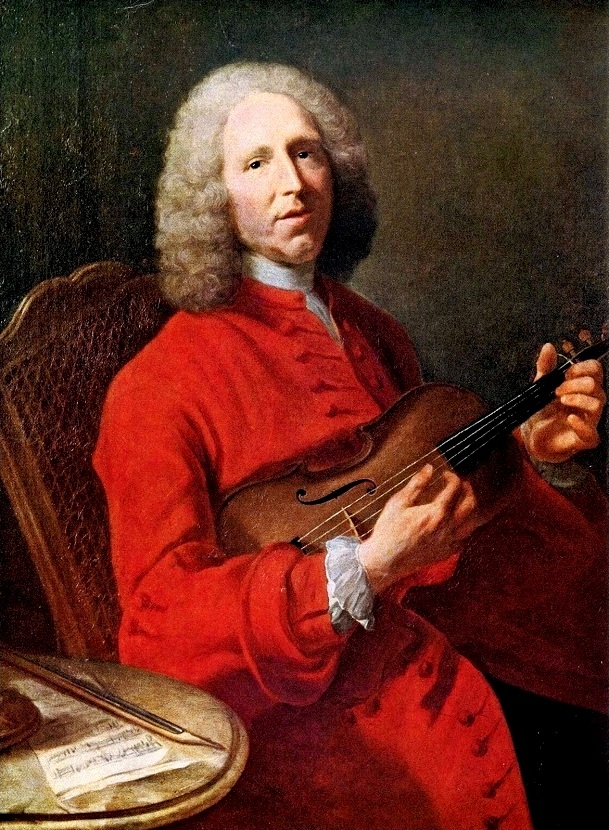
Rameau was the towering genius of French Baroque music — a composer of ravishing operas and harpsichord works who was also one of history's greatest music theorists. He essentially explained how harmony works in his Treatise on Harmony before going on to compose some of the most colorful, dramatically vivid music of the 18th century. His orchestration was so far ahead of its time that Berlioz marveled at it a century later.
0 concerts featuring works by this composer
No upcoming performances scheduled for works by Jean-Philippe Rameau.
New to Jean-Philippe Rameau? These works make great entry points.
An instantly exciting, rhythmically infectious dance that hooks listeners from the first bar — pure energy and color.
Suite in E Minor from Pièces de clavecin (1724): Tambourin
A bright, percussive harpsichord miniature that's immediately appealing and shows Rameau's rhythmic genius.
One of the most beautiful arias in all of French Baroque opera — heartbreaking simplicity and vocal perfection.
Add to Spotlight to be notified when a piece is scheduled near you.
The works that define Jean-Philippe Rameau's legacy.
A spectacular celebration of the exotic that contains some of the most thrilling orchestral and choral music of the Baroque.
His first opera and the work that revolutionized French opera — its dramatic power and harmonic daring still astonish.
Chamber music of extraordinary refinement and invention that rivals anything in the Baroque repertoire.
Musical style, influences, and more
Rameau's music is characterized by extraordinarily bold harmony, brilliant orchestral color, and a dramatic instinct that makes his operas feel almost modern. His dance music has an irresistible vitality and rhythmic snap, while his slow movements achieve an otherworldly beauty. His harmonic language is more daring than virtually any of his contemporaries — full of unexpected modulations, dissonances, and enharmonic surprises.
He was self-taught in many ways, absorbing Italian and French traditions before developing his own theoretical framework. His theoretical rivalry with the partisans of Italian opera (the Querelle des Bouffons) defined French musical life for a generation. He inherited Lully's operatic tradition and transformed it, and his ideas about harmony influenced everyone who came after — from the Classical period through modern jazz theory.
His early decades produced his theoretical masterworks and four magnificent books of harpsichord pieces. His operatic career exploded after age 50, producing a stream of operas and opéra-ballets that dominated the French stage for 30 years. His late works grew increasingly experimental and harmonically adventurous, as he pushed the boundaries of what French Baroque opera could express.
Rameau didn't produce his first opera until age 50. Before that, he was known primarily as a theorist and keyboard composer in relative provincial obscurity. When Hippolyte et Aricie premiered in 1733, it caused a sensation — and a scandal. Traditionalists called it too complex and Italian-influenced, while progressives recognized its genius. Within a decade, the same conservatives were defending Rameau against the next wave of Italian music.
Rameau's Treatise on Harmony (1722) is arguably the most influential music theory text ever written. He discovered the principle of chord inversion, the concept of the fundamental bass, and essentially created the foundations of tonal harmony that are still taught in every music school today.
Rameau is experiencing a golden age of revival. William Christie, Marc Minkowski, Raphaël Pichon, and others have made his operas a regular presence in the world's opera houses. The keyboard works are harpsichord recital staples. Les Indes galantes, especially, has become a crowd-drawing spectacle — Clément Cogitore's hip-hop-infused staging for the Paris Opéra went viral in 2019.
53 works in catalog
Browse the catalog below. Add any work to your Spotlight to track when it is performed live.
Showing 30 of 53 works