1
Hungarian Dances (selections)
Immediately appealing and tuneful, showing his lighter side without complexity.
1833–1897
167 works · 9 upcoming works performed
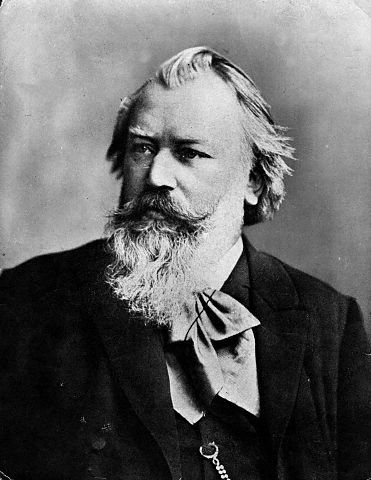
Brahms was the great conservative revolutionary, writing fugues and sonatas in an age of Wagnerian excess while somehow sounding utterly modern. His music combines Beethoven's architectural mastery with a uniquely autumnal warmth and melancholy—it's music that gets richer with age, both yours and its own. He proved that looking backward could be a radical act.
9 concerts featuring works by this composer



Never miss a Brahms performance
Get notified when new concerts are announced near you
New to Johannes Brahms? These works make great entry points.
Hungarian Dances (selections)
Immediately appealing and tuneful, showing his lighter side without complexity.
His 'Tenth Symphony' moment—heroic and dramatic, perfect for Brahms newcomers.
Wiegenlied (Lullaby), Op. 49 No. 4
His most famous melody, introducing his gift for simple beauty.
Add to Spotlight to be notified when a piece is scheduled near you.
The works that define Johannes Brahms's legacy.
His most profound work, a humanistic requiem focusing on consoling the living rather than praying for the dead.
His symphonic masterpiece, ending with a passacaglia that's both ancient and utterly modern.
One of the great violin concertos, balancing symphonic scope with lyrical beauty.
Musical style, influences, and more
Brahms's music is densely contrapuntal yet never academic, featuring rich chromatic harmonies that push tonality to its limits while maintaining structural clarity. His orchestration tends toward warm, dark colors—rich strings, mellow brass—avoiding Romantic spectacle for a more chamber-like intimacy even in symphonies. He had an unmatched gift for developing tiny motivic cells into vast structures, making complexity sound inevitable.
Mentored by Robert Schumann, who proclaimed him a genius at age twenty, creating both opportunity and burden. He absorbed Beethoven's structural thinking and Bach's counterpoint while rejecting Wagner's theatrical excess. His friendship and rivalry with Wagner divided the musical world into camps. He influenced Schoenberg profoundly—the Second Viennese School saw him as a progressive modernist, not a conservative.
Early works showed Romantic fire (Piano Concerto No. 1, Serenades), but Schumann's death and subsequent responsibilities sobered him. The middle period brought his symphonies and major chamber works, achieving perfect balance of emotion and structure. Late works—the clarinet pieces, Four Serious Songs, piano intermezzos—achieved a spare, autumnal profundity, stripping away excess to reveal essence.
Brahms destroyed countless compositions he deemed unworthy, including at least two decades' worth of string quartets before publishing his first at age forty. When asked why he waited so long to write a symphony, he replied that he heard 'the giant' Beethoven's footsteps behind him—the pressure of following the master paralyzed him for years until he finally produced his First Symphony at age forty-three.
Brahms was a serious scholar of early music, editing works by Couperin, editing the complete works of Schubert, and collecting manuscripts—this historical knowledge informed his compositional technique, making him perhaps the most learned composer since Bach.
Brahms is one of the most frequently programmed composers worldwide, with all four symphonies, both piano concertos, and the violin concerto as absolute staples. His chamber music anchors string quartet and piano trio repertoire. He's the definition of evergreen—his music has never gone out of fashion and likely never will.
167 works in catalog
Browse the catalog below. Add any work to your Spotlight to track when it is performed live.
Showing 30 of 167 works