1
Sicilienne in E-flat Major (attributed)
A gentle, lilting melody that appears on countless recital programs — whether or not she wrote it, it captures the graceful Classical style she inhabited.
1759–1824
1 work
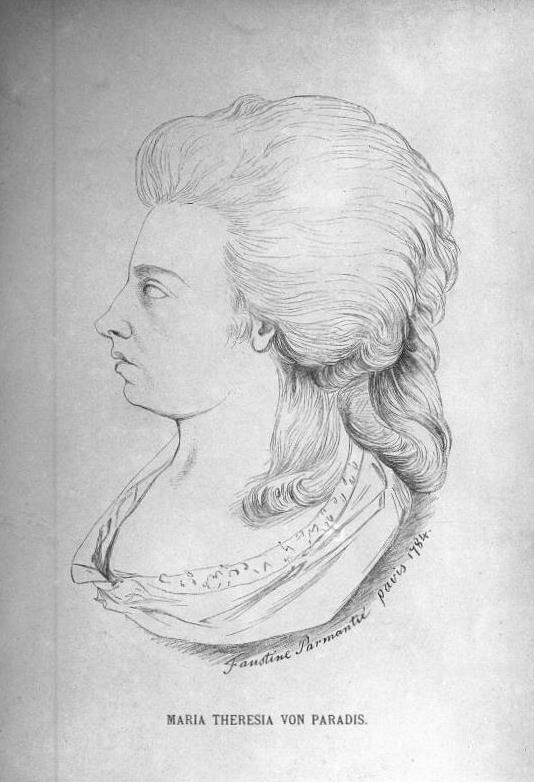
Maria Theresia von Paradis was an extraordinary 18th-century musician — a blind pianist, singer, and composer who performed across Europe, premiered Mozart's Piano Concerto No. 18 (which he likely wrote for her), and founded a music school for the blind in Vienna. Her surviving compositions are few but charming, and her remarkable story of artistic achievement against enormous odds makes her a figure of enduring fascination.
0 concerts featuring works by this composer
No upcoming performances scheduled for works by Maria Theresia von Paradis.
New to Maria Theresia von Paradis? These works make great entry points.
Sicilienne in E-flat Major (attributed)
A gentle, lilting melody that appears on countless recital programs — whether or not she wrote it, it captures the graceful Classical style she inhabited.
Twelve Lieder — Selected Songs
Simple, elegant song settings that are immediately charming and reveal a real sensitivity to poetic text.
Große Militärische Symphonie (attributed fragments)
Fragments of orchestral ambition that suggest a composer capable of working on a larger canvas than her surviving output shows.
Add to Spotlight to be notified when a piece is scheduled near you.
The works that define Maria Theresia von Paradis's legacy.
Sicilienne in E-flat Major (attributed)
Though its attribution is disputed (possibly composed by Samuel Dushkin), this gentle, singing melody has become the piece most associated with Paradis and is beloved by string and wind players alike.
Twelve Lieder
Paradis's surviving songs show a genuine gift for vocal writing in the Viennese Classical tradition — modest in scale but genuinely appealing.
Der Schulkandidat (Singspiel)
One of the few surviving theatrical works, this singspiel demonstrates Paradis's competence as a dramatic composer working in the popular Viennese genre.
Musical style, influences, and more
Paradis's surviving works are composed in the elegant Classical style of late 18th-century Vienna — graceful melodies, clear formal structures, and tasteful ornamentation typical of the Mozart-Haydn era. Her vocal writing shows particular sensitivity to text and a singer's understanding of the voice. The famous 'Sicilienne' attributed to her (likely spurious) has come to represent a style of gentle, singing lyricism.
Paradis was educated by some of Vienna's leading musicians, including Salieri (composition), Koželuch (piano), and Righini (singing). She moved in the same Viennese circles as Mozart and Haydn, and her performing career brought her into contact with the leading musical figures of Paris and London. Her blindness from age three or four led to a remarkable development of memory and ear that awed her contemporaries.
Paradis established herself as a celebrated performer in Vienna before embarking on a three-year European tour (1783-86) that included Paris, London, and Brussels, performing before royalty and earning widespread admiration. After returning to Vienna, she increasingly focused on composition and pedagogy, founding a music institute for young women in 1808 that included blind students. Her compositions, including at least five operas and numerous songs, were largely lost.
Paradis was the subject of a controversial treatment attempt by Franz Mesmer (the origin of 'mesmerism') in 1777. Mesmer claimed to be restoring her sight through magnetic therapy, but when the treatment was interrupted — under murky circumstances possibly involving her parents' fear of losing her disability pension — any improvement was lost. The episode became a cause célèbre and effectively ended Mesmer's Viennese career.
Paradis developed a system of musical notation for the blind using pins on a board — predating Braille's system by decades — that allowed her to compose independently. This innovation in accessibility was as pioneering in its way as her performing career.
Paradis is primarily a historical figure rather than a regularly programmed composer — the Sicilienne is by far her most-heard work, though its attribution is questionable. She appears most often in concerts focused on women composers or historical rediscoveries. Her story is compelling enough to anchor a program even where the surviving music is modest, and her connection to Mozart gives her concert-ready name recognition.
1 works in catalog
Browse the catalog below. Add any work to your Spotlight to track when it is performed live.
Showing 1 of 1 works