1
Piano Piece For Bunita Marcus
Its gentle, spacious piano writing and modest length make it the perfect introduction to Feldman's meditative world without overwhelming the newcomer.
1926–1987
6 works
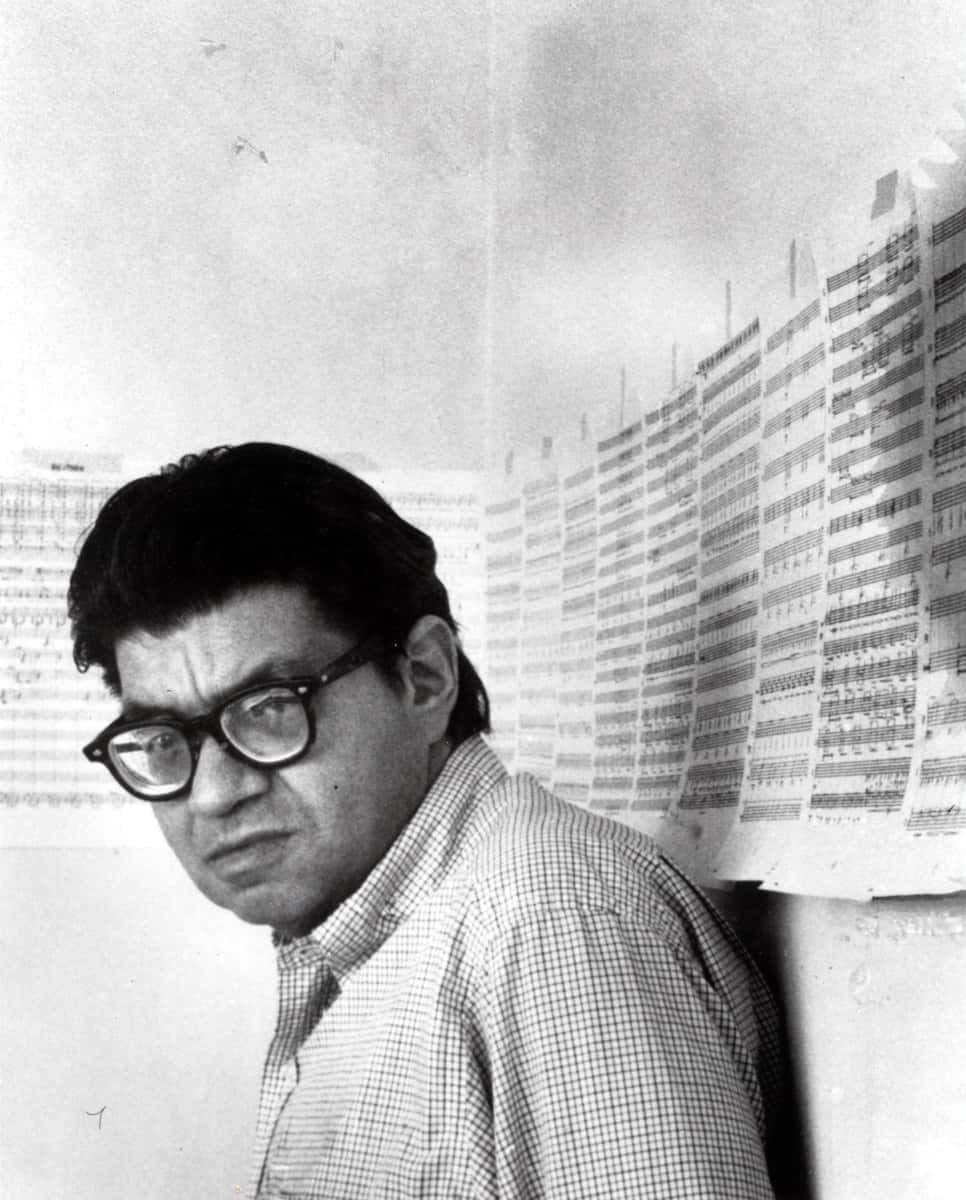
Morton Feldman was a visionary American composer who fundamentally reimagined what music could be—trading virtuosity for intimacy, and climactic drama for patient, meditative unfolding. Working at the intersection of abstract expressionism and sound, he created a body of work that feels as much like visual art as it does music, opening ears to the beauty of silence, sparse textures, and microtonal nuance.
0 concerts featuring works by this composer
No upcoming performances scheduled for works by Morton Feldman.
New to Morton Feldman? These works make great entry points.
Its gentle, spacious piano writing and modest length make it the perfect introduction to Feldman's meditative world without overwhelming the newcomer.
A brief, accessible piece that captures the essence of Feldman's color-based thinking and proves that his music doesn't require hours of commitment to move you.
A solo piano work of moderate length that builds hypnotically and reveals how Feldman could create profound emotional arcs through restraint rather than rhetoric.
Add to Spotlight to be notified when a piece is scheduled near you.
The works that define Morton Feldman's legacy.
A masterwork of spiritual minimalism that transforms the listener into a space of profound silence and color, perfectly capturing Feldman's ability to make quietness monumental.
One of his most perfectly realized chamber works, demonstrating how four instruments can create an entire world of shifting, iridescent sonority.
A solo piano work of devastating simplicity that showcases Feldman's gift for making single notes resonate with meaning across vast stretches of silence.
Musical style, influences, and more
Feldman's music is instantly recognizable for its embrace of quietness, translucent orchestration, and what he called 'careful listening'—harmonies that seem to float rather than progress, often written in a graphic notation that prioritizes texture over strict rhythmic control. His later works stretch into hypnotic, sometimes hour-long meditations where small gestures accumulate into profound emotional weight, creating a kind of sonic equivalent to color-field painting.
A protégé of John Cage who shared his experimental spirit but charted his own path, Feldman was also shaped by his friendship with visual artists like Philip Guston and Mark Rothko, whose influence on his thinking about color and composition cannot be overstated. He emerged alongside the New York School avant-garde yet maintained an independence that resisted easy categorization, dialoguing with serialists and minimalists without adopting their orthodoxies.
Feldman's early works (1950s) experimented with graphic notation and chance operations under Cage's influence, but by the 1970s he had found his true voice in long-form instrumental works of haunting delicacy. His final decade saw the creation of vast, slow-moving masterpieces—some lasting nearly two hours—where his mature style reached its apotheosis, proving that patience and quietude could move listeners as profoundly as any dramatic gesture.
Feldman famously said he wanted his music to sound like 'someone whispering in your ear'—a philosophy born partly from his experience of partial deafness and his resulting heightened attention to subtle sonic details. This disability became his compositional superpower, forcing him to listen differently and rewarding audiences who lean in close.
Though known as an avant-gardist, Feldman harbored a secret love of Beethoven and the classical tradition, and late in life he created works suffused with a quasi-tonal lyricism that surprised those who thought of him as purely experimental—a reminder that his innovations were always rooted in deep musical knowledge.
Feldman's music has experienced a significant revival over the past two decades, moving from cult status among avant-gardists to broader recognition among classical audiences hungry for contemplative, non-commercial art. His works are increasingly programmed in concert halls, though they still require adventurous programming and patient listeners; he remains somewhat countercultural, which is precisely what makes him essential.
6 works in catalog
Browse the catalog below. Add any work to your Spotlight to track when it is performed live.
Showing 6 of 6 works